Blog Large Image Whole Post


Struggling to stand out in a competitive market while driving meaningful revenue growth? You are not alone. The disconnect between brand identity and commercial execution is one of the most common blindsides preventing science and technology companies from scaling with speed and credibility.

The lack of a unified approach to branding and commercial strategy exacerbates these struggles. For example, a strong brand can address pricing objections by emphasizing value, while an informed commercial strategy ensures the brand aligns with market needs. Alternatively, combining these two critical elements can have a “magical” impact on businesses. This is why adopting a systematic and parallel approach to brand creation and commercial planning is critical for overcoming these hurdles.
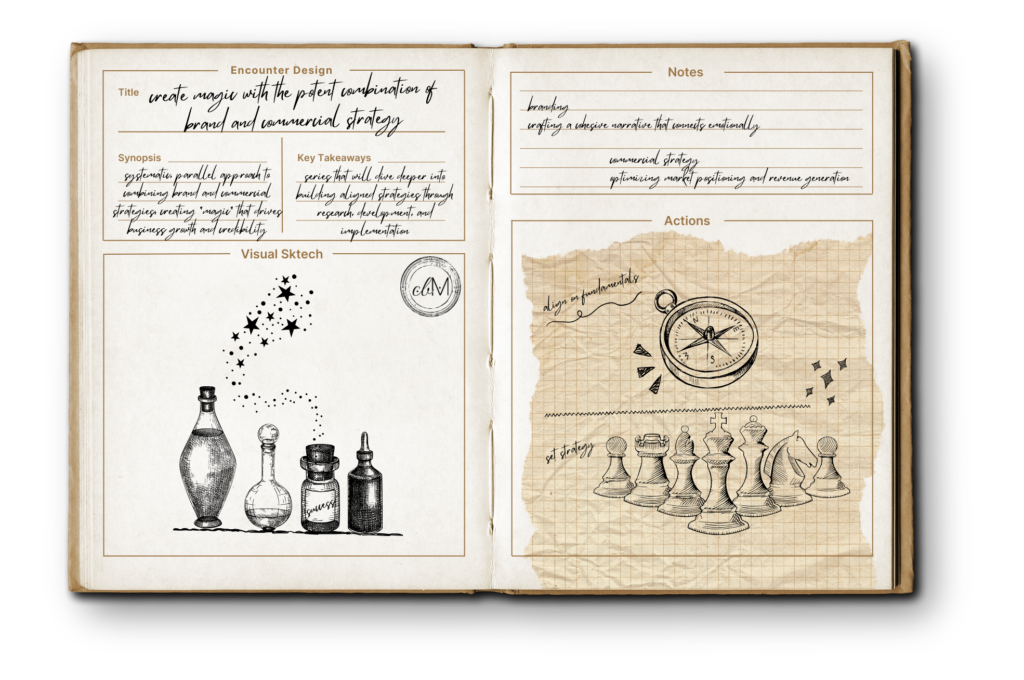
brand & commercial strategy field journal entry

This blog kicks off a new series where we’ll delve into each step of the brand and commercial strategy creation process, exploring how a systematic and parallel approach can streamline complex workflows and deliver exceptional results. From laying the groundwork in research to strategically executing a compelling narrative, we believe in a structured yet flexible process tailored to each organization’s goals and market.

But first, we must get on the same page with some important definitions.

Defining Brand Strategy

At its core, brand strategy is a framework to establish the brand and help it stand out among competitors. It encompasses the values, personality, and story of your brand, shaping every interaction you have with customers and stakeholders. Brand strategy defines your value proposition, target personas, messaging, and visual identity. It’s not just about logo and design; it’s about creating a cohesive narrative that resonates with your audience and fosters trust and loyalty. By crafting a brand strategy that speaks directly to the needs and values of your audience, you establish a recognizable presence in the market that differentiates you from competitors and builds a foundation for long-term connection.

Organizations struggle with branding, making it challenging on a number of levels.

  • Differentiating in a Crowded Market: Standing out often requires a unique value proposition and a cohesive narrative – something that’s frequently overlooked or underdeveloped.
  • Connecting with the Audience Emotionally: Companies often focus heavily on technical features and benefits, neglecting the emotional aspect of decision-making. Building a relatable and compelling brand that resonates with both logical and emotional drivers is a common struggle.
  • Lack of Internal Alignment: Brand creation can falter if key stakeholders within an organization aren’t aligned on the brand’s mission, vision, and values. This misalignment often leads to inconsistent messaging and brand confusion.
  • Scaling the Brand Globally: Expanding into new markets requires adapting the brand to resonate with diverse audiences while maintaining core identity. Striking this balance is a significant challenge.


Defining Commercial Strategy

On the other hand, commercial strategy is the comprehensive plan to achieve business goals and gain a competitive advantage in the marketplace. It addresses the “what” and “where” in terms of product positioning, pricing, customer segmentation, and go-to-market plans. A strong commercial strategy aligns business operations with market demands, optimizing the steps needed to convert awareness into revenue. It’s designed to ensure that every commercial decision – from product development to distribution – is strategically aligned with business goals and maximizes return on investment.

This sounds great, but companies frequently struggle with organizing and implementing their commercial plans.

  • Misaligned Go-To-Market Strategy: Without a clear understanding of the target audience and market needs, B2B businesses often waste resources on misaligned sales and marketing efforts, resulting in missed opportunities and growth.
  • Inefficient Lead-to-Revenue Funnel: Converting leads into paying customers is more complex in B2B sales due to longer sales cycles, multiple decision-makers, and complex buyer journeys. Many businesses struggle with defining and streamlining this process.
  • Pricing and Value Communication: Defining the right pricing strategy for innovative products or services can be challenging. Companies often struggle to balance competitive pricing with communicating the value and ROI of their offerings.
  • Failure to Capitalize on Market Gaps: Without thorough market research and gap analysis, businesses risk focusing on oversaturated areas or developing products/services that don’t fully address market needs.
 

The Systematic Approach: Laying the Foundation

Successful brand and commercial strategies start with a systematic approach in three clear phases:

  • Research & Analysis: Every effective strategy is rooted in a deep understanding of the market and customer needs. This phase involves rigorous research, gathering insights that guide every subsequent decision.
  • Strategy Development: The next phase focuses on developing a strategic blueprint that aligns brand messaging and commercial goals with the company’s vision and market position.
  • Implementation: Finally, the strategy comes to life through a targeted implementation plan that includes every touchpoint your audience will interact with, from the website to sales collateral.

Each of these phases is designed to streamline complexity and ensure that all elements of the brand and commercial strategy work together seamlessly, creating a lasting impact.

Parallel Processes: Unique Tracks for Brand and Commercial Strategy

To maximize impact, we develop brand and commercial strategies as parallel processes that align at each phase yet differ in focus and execution.

The research & analysis phase for brand strategy involves defining a value proposition, mapping personas, and conducting competitive analysis. Meanwhile, commercial strategy focuses on understanding the market landscape with customer segmentation, market gap analysis, and financial analysis. Together, these efforts create a comprehensive picture of opportunities and challenges.

During the strategy development phase the brand strategy takes shape through messaging, positioning, and visual identity, establishing a cohesive brand presence. Concurrently, the commercial strategy centers around go-to-market plans, product architecture, and pricing models that support revenue goals.

Finally, each strategy is implemented with distinct but interconnected assets. Brand strategy elements, such as website design and content, work in tandem with commercial strategy elements like sales collateral and pitch decks, ensuring both brand governance and sales effectiveness.

Why You Need a Thought Partner

Navigating the intricate relationship between brand and commercial strategy is no small feat. The process outlined in this blog is ideal for new companies and simple products, but the reality is that businesses are hardly ever this straightforward. Finding a partner who can meet your business where it is at and still achieve these results can be a gamechanger.

With Creative Bio Marketing, you gain a strategic partner dedicated to helping you create the “magic” that happens when brand and commercial strategy work in harmony. Our systematic and parallel process not only saves time but also positions your brand for meaningful growth and recognition. Together, we’ll craft a strategy that’s as unique as your organization, driving results that resonate today and build the credibility for sustained success in the future.

share this post!

Welcome back to another installment of nerding out on the science of branding, where I deep dive into research and share how you can apply it to your business. Today, we’re discussing brand personality, which is an essential part of branding that goes beyond logos and taglines by resonating deeply with customers and creating lasting emotional connections. Does this seem nebulous to you? You’re not alone. I’ve worked with many clients who are in the same boat. Let’s break down exactly what brand personality is and how to harness its power for your life sciences business.

Research Foundations of Brand Personality

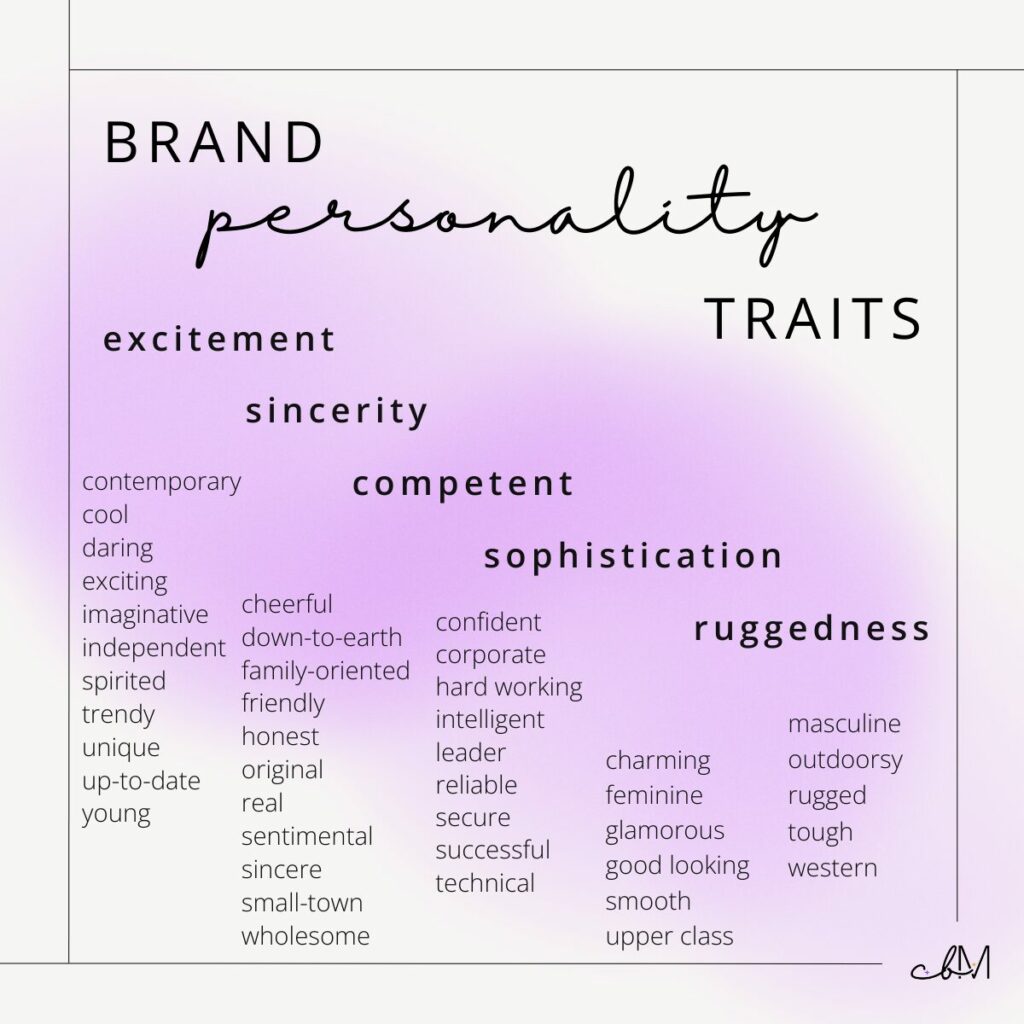
Dimensions of Brand Personality introduced a framework that revolutionized how we perceive brands. The paper defined brand personality as a “set of human characteristics associated with a brand.” Aaker identified five dimensions of brand personality: Sincerity, Excitement, Competence, Sophistication, and Ruggedness. Each dimension mirrors the Big Five human personality traits—openness, conscientiousness, extraversion, agreeableness, and neuroticism—offering a comprehensive model to understand and develop brand personalities.

Interestingly, Aaker noted that some personality facets tap into an innate part of human personality (Sincerity, Excitement, and Competence) whereas others (Sophistication and Ruggedness) tap into a dimension that individuals desire but do not necessarily have. Because of the important nature of work in the life sciences, and the impact that it has on humanity, many brands largely exist in the innate space (Sincerity, Excitement, and Competence).

For instance, a brand might emphasize Competence, showcasing reliability, expertise, and effectiveness. These are critical traits in an industry where trust and precision are paramount. But when considering your brand personality, it could be thought-provoking to explore how Sophistication and Ruggedness play into the desires of your target audience. Can you play off those desires to build loyalty or entice them to take action?

The Predictability → Reliability → Trust Progression

It all comes down to psychology. Humans are inherently driven by emotions and connections. By attributing human traits to a brand identity (aka brand personality), businesses can make their products and services more relatable and approachable to consumers. When customers perceive a brand as having a distinct personality, they are also more likely to form emotional connections, often defending them as they would a close friend. When a brand consistently embodies specific personality traits, it becomes reliable, fosters loyalty, and builds trust.

In the life sciences, where B2B decisions can be complex and stakes high, a brand that communicates trustworthiness and expertise can greatly influence customer preference. Emotional connections, driven by a brand’s consistent and relatable personality, make customers more likely to choose your brand over competitors. While product features, pricing, and customer service are essential, competitors can quickly replicate them. On the other hand, building a trusted brand identity is not so easy to achieve, but can help you carve out a distinct place in the customer’s mind.

How Personality Personifies a Brand

We’re not here to just conduct a thought experiment. Brand personality is actually a very useful tool for implementing the brand on a daily basis. It should seep into interaction and experience. Brand personality manifests through various elements, creating a holistic identity that customers can connect with:

  • Visual and Sensory Identity: This includes logos, color schemes, and overall design aesthetics that convey the brand’s personality. For instance, clean, modern visuals can communicate competence and reliability in the life sciences field.
  • Verbal Identity, Communication Style, and Tone of Voice: The way a brand communicates—its choice of words, tone, and style—can personify its personality. A brand emphasizing competence might use precise, professional language, while one focusing on excitement might adopt a more dynamic and engaging tone.
  • How the Brand Acts: This encompasses the brand’s behavior in the market, including customer service, corporate social responsibility, and community engagement. Actions that consistently reflect the brand’s personality traits reinforce its identity and build stronger customer relationships.


How to Pick Your Brand Personality

We finally made it to the exciting part: choosing your personality traits. It can be helpful to walk through the following steps when selecting your personality traits:

  • Define Your Core Values: Understand what your brand stands for. Core values are step one in breathing life into your brand personality, making it more real. Some common values in the life sciences are innovation, precision, and collaboration.
  • Know Your Target Audience: Analyze who your customers are and what they value. Tailoring your brand personality to resonate with their preferences and expectations is crucial. When a person feels like a brand understands them, they’re more inclined to trust and engage with it.
  • Choose Brand Archetypes: Brand archetypes, such as the Sage or the Explorer, can provide a blueprint for your brand’s personality. Select archetypes that align with your brand’s mission and audience. They can make it easier for consumers to connect with, understand, and remember your brand.
  • Pick 3-5 Personality Traits: Based on your core values, target audience, and chosen archetypes, identify a few key personality traits. These traits should consistently inform all aspects of your branding. If you need a place to start, use the 42 personality traits from Aaker’s publication.


Tips to Keep in Mind

  • Be Comprehensive, Not Specific: As a tool, give your copywriters and designers as much flexibility and breadth as possible to create visual and verbal manifestations of the brand that are contextually appropriate and effective.
  • Consistency is Key: Ensure that every touchpoint, from marketing materials to customer interactions, consistently reflects your brand’s personality.
  • Evolve with Your Audience: As customer preferences and industry dynamics evolve, be prepared to adapt your brand personality without losing sight of your core values.
  • Go Beyond Standard: Let’s be honest. In the life sciences, everyone is passionate about their mission. That’s table stakes. Instead, think about your why. Strive to create an emotional connection with your audience. Emotional bonds can lead to lasting loyalty and advocacy.
  • Monitor and Measure: Regularly assess how your brand personality is perceived and make adjustments as needed to stay aligned with your goals and audience expectations.


By thoughtfully developing and consistently expressing a distinct brand personality, life sciences companies can differentiate themselves, build trust, and foster deep connections with their audience. Whether you aim to project competence, innovation, or compassion, a well-crafted brand personality is your key to standing out in this competitive field.

 
If you're ready to reap all the benefits of an awesome brand identity...

In a world where scientific breakthroughs and technological marvels are everywhere, standing out in the life sciences sector requires more than just innovation – it demands a touch of magic. Enter life sciences branding strategies, specifically the use brand archetypes, which breathe life into your brand’s story and create an emotional connection with your audience. As a foundational component of your brand’s personality, these archetypes are the secret sauce that can elevate your brand from blending in to breaking through.

what are brand archetypes?

The concept of archetypes was originally conceived by psychologist Carl Jung and are based on universal patterns that are familiar to everyone. They trigger instinctive responses in consumers. For instance, the Mother archetype is nurturing, caring, and reliable.

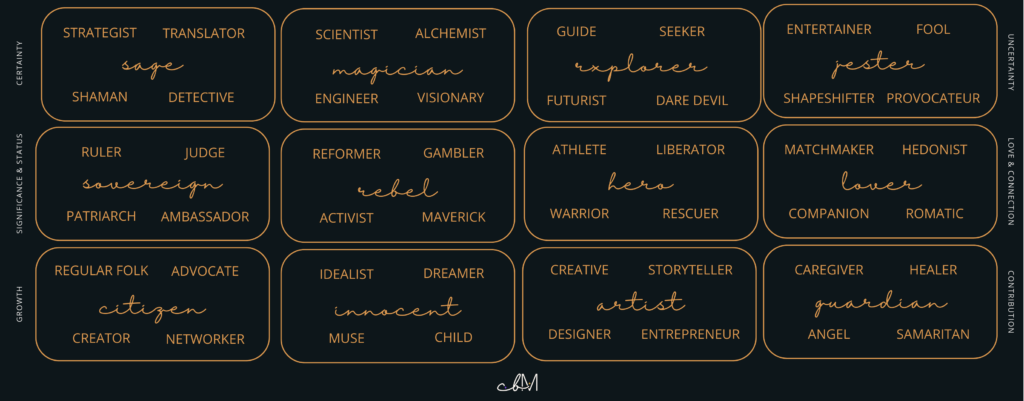
In 2001, 12 distinct brand archetypes were identified by Mark and Pearson’s seminal work: The Hero and The Outlaw: Building Extraordinary Brands Through the Power of Archetypes. This framework suggested that brands should rely on a single archetype or risk being afflicted by “brand schizophrenia” (aka having no identity instead of a strong identity.) These primary archetypes can be further expanded and differentiated into a grid of archetypes based on dichotomies; certainty versus uncertainty, significance & status versus love & connection, and growth versus contribution. In total, the matrix offers 60 unique archetypes that brands can use to elicit emotional reactions and build connections with their audiences.

Brand Archetypes Map

Counter to Mark and Pearson’s claim that brands should rely on a single brand archetype in their marketing efforts, a 2023 publication in Business Horizons demonstrates that some of the fastest-growing and most well-known/respected brands leverage multiple archetypes in their strategies. In fact, the research found that less than 2% of brands (out of over 2,400 in the dataset) associated with a single archetype. Alternatively, most brands evoked at least two or three archetypes in their marketing communications. The authors note that emerging channels and technologies enable brands to use a wider range of touchpoints in their marketing communications. They conclude that reliance on multiple archetypes has become increasingly important for standing out in crowded markets.

Key Archetypes for the Life Sciences

But let’s rewind for a moment: despite this recent evidence, life sciences companies are notorious for defaulting to common brand archetypes. In many cases, when there is no real brand strategy, a common archetype may arise organically. Other times, there is a strong reliance on a single traditional, well-loved archetype. Regardless, this makes it very difficult for companies to stand out and gain the visibility they would like to achieve with their targets.

So, what are those archetypes?

The Sage

  • Impacts: wisdom, knowledge, expertise
  • Qualities: insight, intelligence, analysis

Any life sciences company that leverage expertise that enables discoveries and developments are likely employing The Sage archetype. The Sage Family includes the Strategist, The Translator, The Shaman, and The Detective.

Who does this? An example of a company that relies primarily on the sage is Thermo Fisher Scientific. They emphasize that they are advancing science through state-of-the-art equipment and solutions.

The Magician

  • Impacts: transformation, change, wonder
  • Qualities: visionary, catalyst, charismatic

Companies that position themselves as change-makers for transforming scientific research and enabling breakthroughs that seem almost impossible are probably leveraging The Magician archetype. The Magician Family includes The Scientist, The Alchemist, The Engineer, and The Visionary.

Who does this? 10X Genomics is an example of a company that focuses on how its technologies unlock new biological underpinnings.

The Explorer

  • Impacts: freedom, discovery, adventure
  • Qualities: ambition, curiosity, seeking

Those who are pushing the boundaries of what is possible in science and technology often adopt the Explorer archetype. The Explorer Family includes The Guide, The Seeker, The Futurist, and The Dare Devil.

The Hero

  • Impacts: courage, bravery, triumph
  • Qualities: strength, resilience, determination

When the stakes are high and a company is focusing their efforts on conquering a disease or large-scale problem, it often embodies The Hero archetype. The Hero Family includes The Athlete, The Liberator, The Warrior, and The Rescuer.

The Creator

  • Impacts: innovation, imagination, originality
  • Qualities: visionary, artistic, inventive

Organizations who focus on creating custom solutions for those in their market often claim The Creator archetype due to their innovative approaches and strong problem-solving abilities. The Creator is part of The Artist Family, which also includes The Storyteller, The Designer, and The Entrepreneur.

Who does this? CROs such as Charles River Laboratories highlight its creative and flexible solutions in the drug discovery and development space.

The Caregiver

  • Impacts: compassion, nurturing, protection
  • Qualities: altruism, service, support

Companies who are committed to improving end outcomes such as patient lives, and advancing health and science often embody the Caregiver archetype. The Caregiver is part of the Guardian Family, which also includes The Healer, The Angel, and The Samaritan.

Who does this? Many therapeutic developers, such as Genentech, will leverage their dedication to saving and transforming lives with its innovative therapies.

The Ruler

  • Impacts: leadership, responsibility, control
  • Qualities: authority, power, order

Established companies that claim a strong leadership presence in a market often embody The Ruler archetype. The Ruler is part of the Sovereign Family, which also includes The Judge, The Patriarch, and The Ambassador.

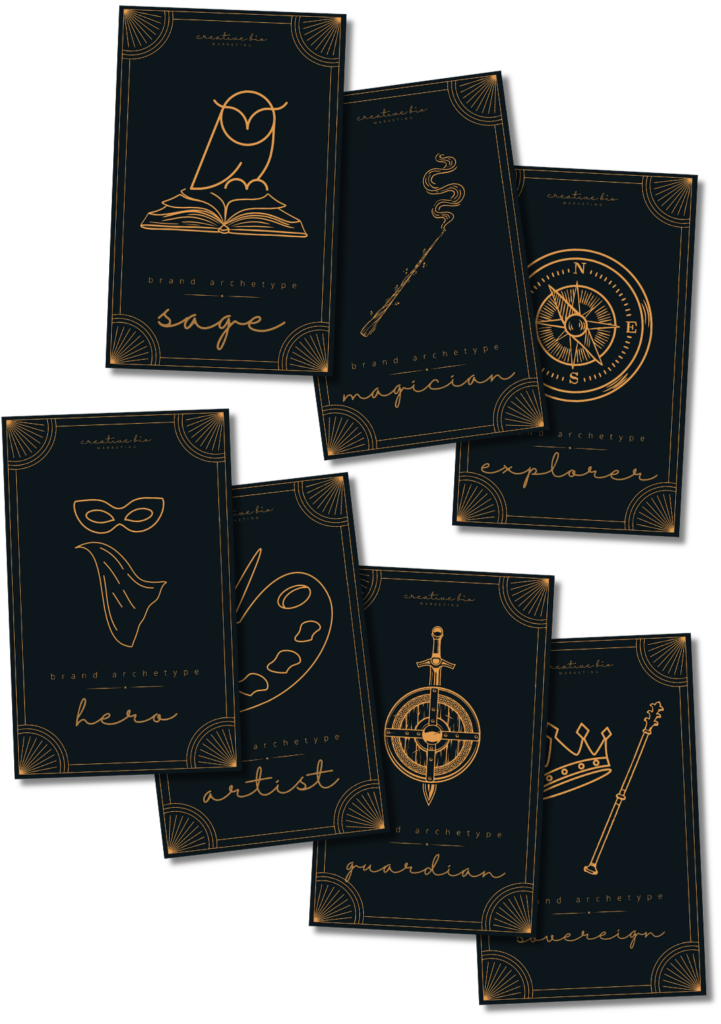
Common Life Sciences brand archetypes

Why Life Sciences Brands Should Consider Multiple Archetypes

Complexity is the name of the game in the life sciences. It seems that it is required for innovation and makes for an interesting challenge for marketers. First, innovation happens for many reasons. For example, a therapy is not developed solely on the basis of compassion (Caregiver archetype) but also because there is an ingenious technological breakthrough enabling it (Engineer archetype). An organization may want to play off both angles in various communications to build the trust and credibility they need to impact the market.

Second, I’d argue that limiting a company to a single archetype is a deadly tactic for many life sciences companies. Take life science tools companies, for instance. They must simultaneously message to executives at large pharma and biotech companies, funding agencies/investors, and researchers. These are extremely diverse groups filled with unique personas and who require individualized messaging. Sticking to a single archetype for all marketing could make this nearly impossible.

Alternatively, brands that identify several core archetypes (all of which are still authentic to the company and what it stands for) will benefit from the flexibility and freedom to create several compelling storylines in their marketing communications based on each target and where they are in the customer journey.

Implementing Archetypes in Your Life Sciences Branding Strategy

As a brand strategist, I’d like to emphasize that brand archetypes are just one piece of a very complex puzzle. But they are can be extremely useful guiding tools that can ease your commercial operations if leveraged correctly.

Step 1. Competitive Analysis

It is critical to assess the main narrative approaches in competitors’ brand massages. Creating a competitive map of archetypes used by competitors can help a company determine was resonates with the target audiences and understand how competitors are meeting the emotional needs of the audience. After mapping competitors, a company must undergo the same process to evaluate its own brand, analyzing its emotional drivers and mapping natural areas of overlap with competitors.

Step 2. Development

Through workshops with key internal and external stakeholders, brands must explore the emotional relevance of various archetypes. Tying archetypes to the mission and vision of the organization is a good place to start evaluating the fit of each archetype. Companies should also solicit feedback from customers and the larger market to evaluate various archetypes to resonate with customers’ needs and preferences. Market research data can often be helpful in this effort. This is also the time to explore how combinations of archetypes can provide additional value to the brand.

Step 3. Integration

Now it’s time to craft narratives over time across the different stages of the customer journey. Companies may want to employ different archetypes during the awareness stage to build interest and rely on a different archetype when driving customers to take action. And as always, it’s important to continuously assess the effectiveness of your archetypes and adjust as needed.

Whether you are just getting started or well on your way, you’ll be glad that you took the time to establish a strong and relatable brand identity. By leveraging the power of brand archetypes, your company can not only stand out in a crowded market but also build deeper connections with your audience. Leveraging the right archetype(s) can transform your branding strategy and propel your company to the next level.


Ready to unlock the magic of archetypes?

five reasons Why AI can’t Replace Human Expertise in Life Sciences Marketing


Hi there, your friendly content strategist here. Today, I’m sharing some news that might break your heart – sorry, not sorry! If you are like me, your newsfeed – wherever that may be – is filled with AI this, and AI tool that… It’s quite overwhelming and the promises are steep. So what’s the deal with AI? Can it really handle all your marketing needs?

AI Limitations in the Life Sciences

Well, my colleagues, sadly due to AI limitations in the life sciences and healthcare sectors, the answer is naught – bummer! But I’m here to share five reasons why you might not want to use it anyway.

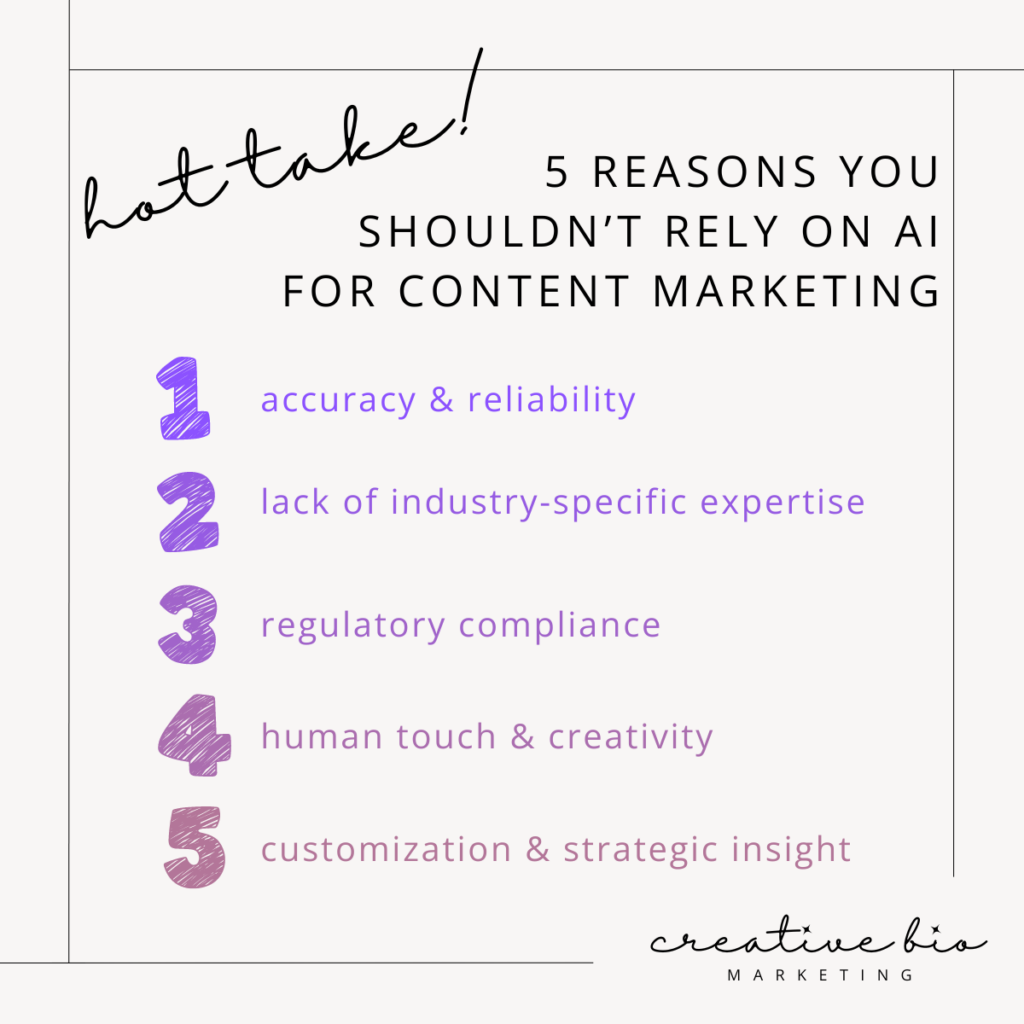
5 reasons you shouldn't rely on AI for content marketing in the life sciences

1. Accuracy and Reliability

The life sciences and healthcare fields require highly accurate and reliable information due to their complex and technical nature. Tools like ChatGPT, while knowledgeable, may not always provide the most up-to-date or precise details. This can potentially lead to misinformation, which can have serious ramifications.

I recently saw a post with a bunch of screenshots of Google’s AI search engine results, and it’s the perfect example of the importance of getting things right. The post demonstrated that Google was “manufacturing” information to generate responses in the most concerning way possible. And when it comes to your products and services, you absolutely do not want some obscure technology that you cannot influence making up facts that might misrepresent your brand and message. My takeaway is that humans should be a critical part of any content creation process in the life sciences.

2. Lack of Industry-Specific Expertise

The vast and varied life sciences and healthcare sectors require a deep-seated understanding of scientific technology and landscape, regulatory requirements, and a pulse on the thumb of emerging and innovative breakthroughs. To make things more complicated, all these things are occurring simultaneously at lightspeed and at a snail’s pace. Not a soul out there would describe it as easy to understand.

Now, when it comes to AI, it’s only as good as the information that goes into the model. There is so much power in being able to infer trends and determine value based on all the inputs listed above. For AI to give the same output as a human being, it would need perfect data being continuously fed into its models, and that’s just not happening – at least not yet.

Case in point: I asked ChatGPT why it is limited to created content in the life sciences, and it said, “ChatGPT might lack the nuanced expertise needed to craft content that resonates with professionals in the field or adheres to strict industry standards.” So there you go. It’s really the deep industry knowledge and years of history dealing with complex and scientific technology that makes scientific content creators and marketers so good at crafting brand stories.

3. regulatory compliance

Let’s talk about the complex legal regulatory landscapes that exist in the life sciences and healthcare sectors. As mentioned above, the regulatory landscape undergoes constant updates. This, in combination with regional differences in regulations, makes it challenging for an AI model to incorporate into content outputs. AI tools may also lack the ability to interpret the context and intent of regulations. For instance, while ChatGPT might generate content that appears compliant, it may inadvertently imply off-label uses of a drug, which is strictly regulated. Such language needs human oversight, especially for organizations with regulated products.

So, when it comes to regulatory content, humans are a crucial part of the equation to ensure that regulatory standards are met and to significantly reduce the risk of inadvertent non-compliance arising from AI-generated content. Having humans at the center thus protects and validates any life sciences or healthcare business.

4. human touch & creativity

This is my personal favorite reason – but then again, I might be biased. While AI tools like ChatGPT can spit out some pretty accurate and technically logical information, they tend to lack the flair and creativity needed to make brands stand out. For instance, I’ve never seen an AI spit out an illustrious alliteration – have you? 🤔

Furthermore, authentic content creation is about tying the mission of the organization to the outcomes that could be achieved if a given technology, solution, or service is successfully implemented in the marketplace. This is a task that requires deep understanding and empathy.

Let’s think about content as a game of poker. Like many of the topics already mentioned, nuance and accuracy are the price of buying into the game, while creativity and human touch are the royal flush that will guarantee success in branding and content efforts.

5. customization & Strategic INSIGHT

Marketing strategies in the life sciences and healthcare sectors require custom approaches to reaching target audiences, penetrating target markets, and featuring specific products and services in a favorable light (see my branding strategy blog for a great place to start). And I would argue that while AI can probably generate content that meets some of these objectives, it definitely cannot meet all of them. In my experience, AI-generated marketing plans are technically complete (contain all of the necessary components), but are often generic and do not fully incorporate and highlight the true unique value of life sciences and healthcare brands.

Developing a coordinated, strategic marketing brand and content plan requires human marketers and strategists who can analyze the market, evaluate the competitive landscape, and incorporate customer feedback. While there is a great deal of data gathering in this process, the true value of humans in this process is the ability to comprehend, synthesize, and create without the bounds needed for any brand. The expertise that comes from professionals working in life sciences and healthcare is the glue that holds it all together to accelerate and ignite your marketing efforts so that companies can achieve their business objectives.

My take on AI

After writing all these reasons why AI is not the perfect tool for content creation in the areas where I specialize, I do want to recognize how helpful it can be as a tool to assist in parts of the content creation process.

I often explain that it helps with “writer’s block.” When before I felt like banging my head against my desk, not knowing where to start, with the iconic blinking text cursor on an empty page, now I simply head over to ChatGPT and ask it to give me an outline or suggest a relevant topic. Sometimes, I even throw all my stream-of-consciousness ideas down and ask it to put together a draft based on all my blatherings. Again, the results are never perfect – but it’s a jumping-off point.

Generally, I’m excited for the future of AI and how I can use it to help clients build amazing brands and tell beautiful stories. I, for one, will strive to stay up-to-date on the latest AI advancements for content creation, marketing, and scientific endeavors, with the hope that technology can help us humans in more meaningful ways.

And that’s all for now, my friends. I’d love to know your thoughts. Do you agree? Do you disagree? Let me know!”

Ready to get organized and start creating powerful content?

unblocking success: the vital role of brand strategy in life sciences


Everyone knows that science rocks! But in the life sciences, it often seems that research and innovation take center stage of a company’s identity, leaving branding as an afterthought. And that is risky business.

While popular opinion says that brands are synonymous with a logo or a tagline, the truth is branding is actually the heartbeat of how life sciences companies communicate with the world. Without a proper branding strategy, life sciences companies run the risk of missing the mark when it matters most.

Why Branding Matters in Life Sciences

In the context of life sciences, branding transcends superficial aesthetics like logos or color schemes. At its core, branding is about forging meaningful connections with stakeholders, fostering trust, and ultimately driving positive outcomes in healthcare and beyond.

human first, b2b second

Unlike consumer goods, where the target audience is often the end consumer, life sciences companies primarily cater to professionals and institutions. However, it’s essential to remember that behind every purchase decision lies a human being. Thus, effective branding in life sciences must prioritize the human element, engaging with customers on a personal level, and articulating the ‘why’ behind the science.

To achieve the desired connection with the target audience, companies must understand their ‘why.’ Unarguably, the life sciences industry has it easier than most because of their direct impact on lives. Whereas others operate in the nice-to-have economy, life sciences exist to solve critical needs in society. The criticality of this work serves as the centerpiece of all life sciences brands.

building trust to influence change

As a biotech, pharma, or healthtech company, precision and accuracy are paramount to success. It might be surprising to discover that branding plays an essential role in conveying the seriousness and integrity of a company’s science and tech. If the audience buys into and trusts the information and brand shares, they will be much more likely to have a positive opinion of that company. Trust is essential in life sciences branding and helps companies build critical brand equity (the social value of a brand), which can make or break a company.

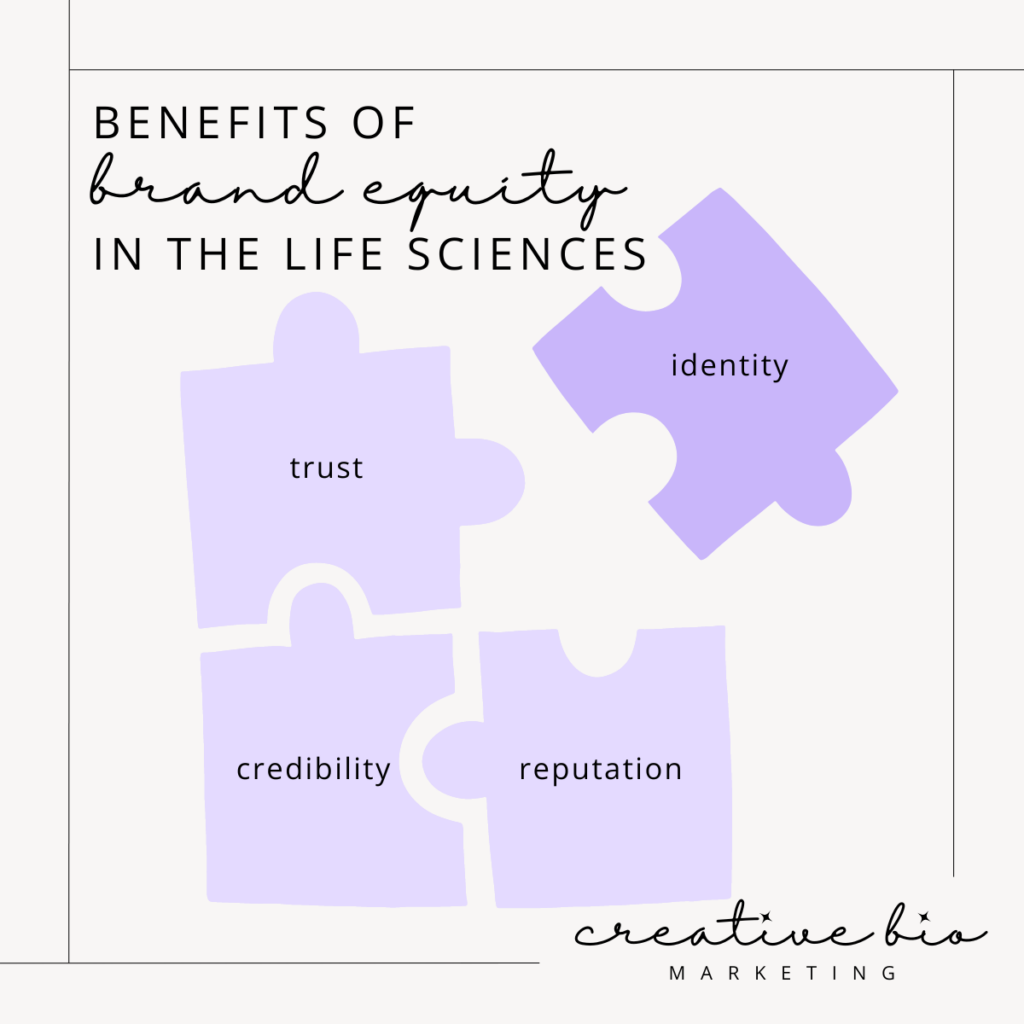
beneifts of brand equity in the life sciences (brand strategy in life sciences)

Strong brand identity instills confidence in stakeholders – from pharma scientists to healthcare providers and even to patients – influencing smoother adoption of products and services. Reputation is often an underlying factor influencing these decision-makers. Therefore, establishing credibility through consistent branding efforts is perhaps one of the most impactful ways to influence market perception and gain a competitive edge.

Challenges in Branding for Life Sciences

Despite its undeniable importance, crafting a compelling brand strategy for life sciences companies comes with its own set of challenges. From balancing technological innovation with relatable messaging to navigating the intricate landscape of regulatory compliance and market access, life sciences companies must tread carefully to ensure their branding efforts resonate with the intended audience – or even multiple audiences (think investors, government agencies, etc). Brand strategy in life sciences is a careful balancing act that does not just happen but is rather meticulously constructed (by your friendly brand strategist 🙂).

Balancing Technology and Messaging

Do you know how to build a ship? My guess is no. Would you then expect a marine engineer to know the nuances of your technology? It is all too easy to assume that your targets speak the language and have the exact same knowledge as you. In reality, everyone has a different background and perspective. It’s the great equalizer.

This is one of the primary challenges that life sciences companies face when it comes to branding. The right balance must be struck between showcasing technological advancements/capabilities and communicating effectively with the target audience. The challenge lies in the fact that the target audience contains both technical (i.e. pharma and healthcare executives) and non-technical individuals (i.e. patients.) While the allure of cutting-edge innovation is undeniable, it’s equally crucial to translate complex scientific concepts into digestible narratives that resonate with all stakeholders. The sweet spot lies in the ability to activate human emotion and back it with reasons to believe in innovation. There are many ways to approach this challenge, but having a solid brand foundation is key.

Differentiating Among Competitors

In an industry where innovation is standard, how does a company stand out? Leaning on technology is not enough. There are thousands of startups with thousands of great ideas. But it is only the brands that can clearly articulate their value and get buy-in to their version of the future that are successful. Too many companies fail to stand out from the competition, whether it be during a funding raise, or when it comes to selling products or services. Again brand strategy is key. For instance, a strong, inspiring brand story and messaging provides life sciences companies with a mechanism for clearly articulating and sharing a unique value proposition to stand above the crowd.

Complex, Heterogenous Targets

Another unique challenge faced by all life sciences companies in some way, shape, or form is navigating regulatory hurdles. Whether it’s dealing with the regulatory burden during discovery to securing market access to innovative therapies, there is a great deal of effort and planning that goes into building strategic partnerships and proactive engagement with regulatory agencies and even payers. These are additional potential stakeholders within a life sciences company’s target audience and add to the complex heterogeneous mix of individuals that brands must resonate with. This emphasizes the essential need for a brand strategy that accounts for these complexities and offers a path toward building equity among these groups.

Crafting a Comprehensive Brand Strategy

So, what exactly does a robust brand strategy entail for life sciences companies? Enter the brand playbook – a comprehensive roadmap that guides all marketing and brand communication actions. By leveraging the Creative Bio Marketing approach, life sciences companies can encapsulate their brand strategy in a playbook that not only aligns with their overarching goals but also resonates with their target audience on a profound level.

In conclusion, while the world of life sciences may be driven by groundbreaking discoveries and technological innovations, the importance of branding cannot be overstated. From fostering trust and credibility to navigating regulatory complexities, a well-crafted brand strategy serves as the foundation of success in this dynamic and ever-evolving industry. By prioritizing human-centric communication and differentiation, life sciences companies can unlock new pathways to success and make a lasting impact on global health.

So rock on, rockstars!

"Let's rock today" from School of Rock

want to learn more about our approach to brand strategy?

leveraging content creation in life sciences: not a nice-to-have, but a must-have


At Creative Bio Marketing, we talk about the dynamic and innovative nature of the Life Sciences industry and how audiences can struggle to keep pace. In this landscape, content creation is a critical tool for communication, education, and engagement. Whether it’s about elucidating complex scientific concepts, disseminating groundbreaking research findings, or fostering meaningful connections with audiences, content creation in Life Sciences is pivotal in driving inbound strategies and nurturing relationships.

Out With The Old – In With The New

Traditionally, outbound marketing tactics such as cold calling and mass advertising have dominated various industries, including Life Sciences. However, with the rise of content marketing, there has been a significant shift towards inbound strategies. Rather than interrupting potential customers with intrusive ads, inbound marketing focuses on creating valuable and relevant content that naturally attracts, engages, and retains audiences.

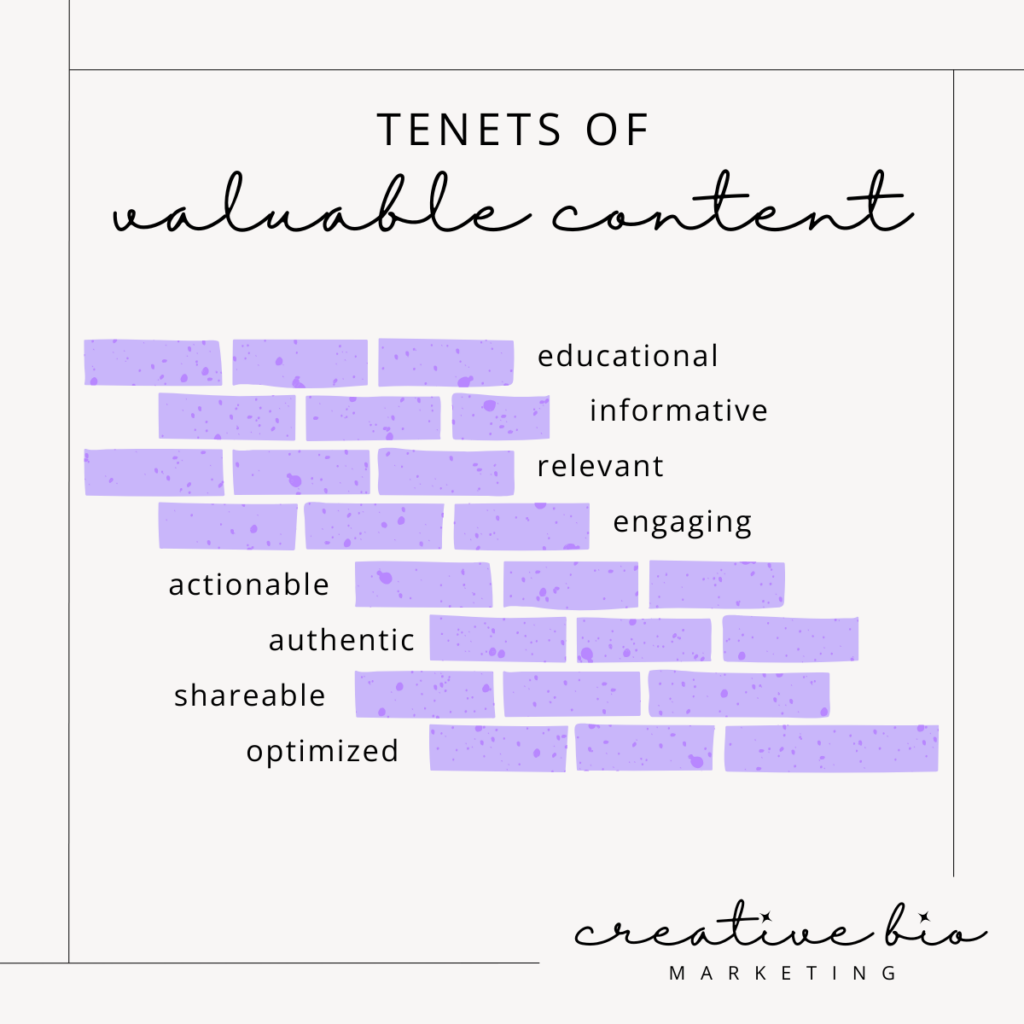
In the paradigm shift from outbound to inbound marketing, there’s a valuable lesson to be gleaned from the strategies employed in business-to-consumer (B2C) marketing. In the B2C realm, content often occupies a prominent position, harnessing the power of engaging storytelling and informative resources to captivate audiences (See the 8 Tenets of Valuable Content). While Life Sciences businesses may initially perceive themselves as distinct from B2C, they ultimately seek to connect with the same individuals. Consider this: a lab director perusing scientific journals might also be the same individual shopping for a new TV, or a scientist researching innovative methodologies might also have an interest in household cleaning products. B2C markets have taken advantage of emerging content platforms to engage their audiences, and there’s ample opportunity for Life Sciences companies to follow suit.

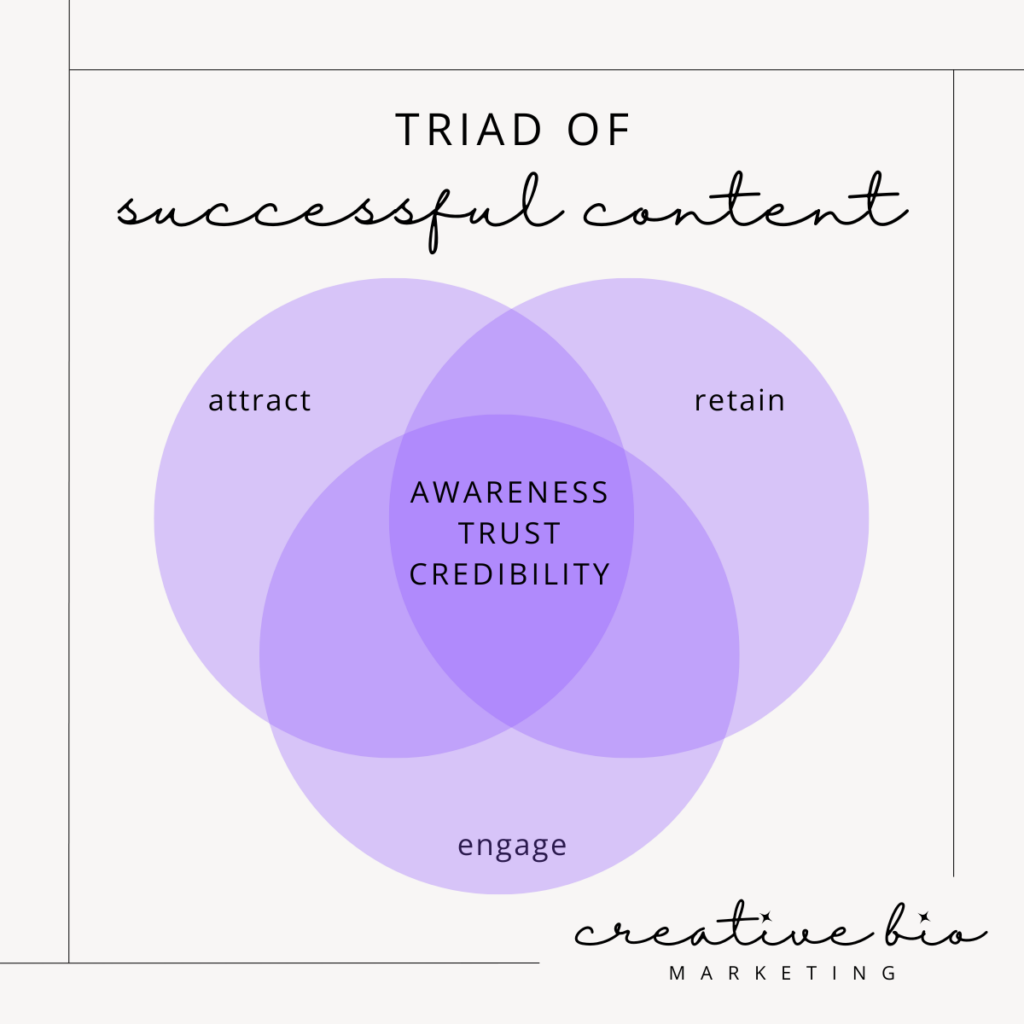
Attract, Retain, and Engage: The Triad of Success

Content creation serves as the cornerstone for attracting, retaining, and engaging both potential and existing customers in the Life Sciences sector. By providing informative and educational content tailored to the needs and interests of their target audience, Life Sciences companies can establish themselves as trusted sources of information and thought leaders in their respective fields. For example, detailing how a new technology platform can improve a scientist’s workflow or demonstrating how a new tool can provide significant ROI for a company adds tangible value to the audience’s professional endeavors. This not only helps in building brand awareness but also fosters long-term relationships based on mutual trust and credibility.

Diagram of the triad of successful content creation in life sciences

Providing Value: A Big Business in B2B

The statistics speak for themselves: content marketing is no longer just a supplementary strategy but a fundamental aspect of business growth in the B2B space. According to surveys by HubSpot and Forbes, content marketing has proven to be essential for raising brand awareness, generating demand and leads, and nurturing subscribers and audiences. Moreover, it offers a substantial return on investment (ROI) when executed effectively.

Various channels offer unique opportunities to engage with life sciences audiences. From in-person events and webinars to email newsletters and blogs, each channel presents its own set of advantages for reaching and resonating with target demographics. As video content continues to gain traction, leveraging this medium can unlock untapped potential and establish thought leadership in the industry. In summary, there are so many ways for Life Sciences companies to start reaping the benefits of effective content marketing.

Keys to Success: Knowing Your Audience and More

While many organizations recognize the importance of content marketing, 28% of B2B marketers say their organization is extremely or very successful with content marketing. As with any other part of the business, achieving success in content creation and marketing requires a strategic approach. Top performers in content marketing attribute their success to several key factors, including:

Understanding the audience

  • Tailoring content to resonate with the specific needs and preferences of the target audience

alignment with objectives

  • Ensuring that content aligns with the organization’s goals and objectives

measurement and demonstration of performance

  • Effectively tracking and analyzing content performance to demonstrate ROI

thought leadership

  • Establishing authority and expertise through insightful and innovative content

collaboration and documentation

  • Fostering collaboration across teams and documenting a cohesive content strategy

In conclusion, content creation is not just a buzzword; it’s a strategic imperative for success in the Life Sciences industry. By embracing inbound strategies, providing value through educational content, and leveraging diverse channels, Life Sciences companies can effectively engage with their audience and drive unprecedented business growth.


Ready to get organized and start creating powerful content?

The Blueprint for Creating Valuable Content: 8 Tenets To Remember


In the fast-paced realm of life sciences, innovation unfolds at a relentless pace, driving advancements that shape the future of healthcare, biotechnology, and pharmaceuticals. Yet, amid the whirlwind of breakthroughs, many companies find themselves struggling to captivate audiences and maintain relevance in the ever-evolving landscape. This challenge underscores the critical importance of valuable content creation as a cornerstone of successful marketing strategies.

Crafting content that not only captures attention but also resonates deeply with audiences amidst the noise is no longer just advantageous – it’s essential. While this might appear daunting, mastering the principles of valuable content creation is the cornerstone of success. By adhering to the guiding tenets detailed below, any team can elevate their brand to new heights, standing out as leaders in their industry.

Key Tenets of Valuable Content

Integrating the following guiding tenets of valuable content creation into your content creation process is a sure way to maximize the engagement and impact of your content.

Tenets of valuable content creation graphic

1. EDUCATIONAL

  • Educates the audience on specific topics, and provides them with useful information that helps them solve a problem or achieve their goal. This type of content establishes credibility, and positions any brand as a trusted source of expertise.

2. Informative

  • Informs the audience about industry trends, market insights, or product/service features helps to keep them informed and engaged. Informative content adds value by providing valuable context that the audience can use to make informed decisions.
    • BONUS: Don’t be afraid to niche down. The people who care about your topics will know the value of the information provided and return for more. This is a great early step that any brand can take to start building a vibrant community.

3. relevant

  • Valuable content is tailored to the needs, interests, and pain points of the target audience. It addresses specific challenges or interests that resonate with the audience, ensuring that the content remains relevant and valuable to them.
    • BONUS: Evergreen content that remains relevant and valuable over time, continues to deliver conversions over many months or even years after its initial publication.

4. ENgaging

  • Through the use of storytelling, interactive elements, visuals, or multimedia capture the audience’s attention and keep them interested throughout the content consumption process. This content enhances engagement and encourages audience interaction.

5. actionable

  • Valuable content provides actionable insights or takeaways that the audience can implement in their own lives or businesses. Actionable content empowers the audience to apply what they’ve learned, leading to tangible results or improvements.

6. authentic

  • Authentic content reflects the brand’s values, personality, and voice while resonating with the audience on a personal and genuine level. Authenticity builds trust and fosters deeper connections with the audience, making the content more impactful.

7. shareable

  • Valuable content is shareable — and easy to share, meaning that it’s highly likely to reach a larger audience. Shareable content extends the reach of the brand and amplifies its message, driving more traffic and engagement.

8. optimized

  • Content that is optimized for search engines, social media platforms, and other channels maximizes its visibility and reach. Optimization ensures that the content is easily discoverable by the target audience and aligns with their search intent.

By prioritizing educational, informative, and engaging content that resonates with audiences, brands can forge deeper connections, drive engagement, and ultimately achieve their goals.

From mastering the art of storytelling to embracing authenticity and optimizing for visibility, integrating these tenets into the content creation process is key to unlocking success in the ever-evolving world of life sciences. With a strategic approach grounded in these foundational principles, teams can navigate the complexities of content creation with confidence, propelling their brands into the spotlight and helping them drive meaningful results.


need help with your content strategy?

This is our sweet spot, and we’d love to help you get started. Whether you need help with ideation or execution, we’ve got you covered!

Introducing Creative Bio – Transforming Knowledge Into Impact


Greetings, everyone! Welcome to Creative Bio, your guiding light in navigating the convergence of knowledge and impact. As we embark on this journey together, I invite you to join me on a reflective journey through time. Through sharing fragments of my own story, I hope to offer you valuable insights and inspiration.

Inquisitive Minds Cannot Be Stopped

From a young age, I’ve been the one to raise questions, seeking to understand the world around me. Yet, for the first three decades of my life, I found myself conforming to societal norms, stifling my innate curiosity. Despite this, I pursued academic excellence and ventured into the corporate world, only to feel constrained by its rigid structures.

While I found academic culture exhausting, it laid the groundwork for all my future endeavors, instilling in me a solid research foundation and shaping my core values.

In my late twenties, as Editor in Chief, I was on the brink of unprecedented success. Despite facing external obstacles, an undeniable sense of momentum fueled my pursuits. As I progressed, I realized pivoting away from journalism was essential for my well-being.

This realization led me to the role of Head of Brand and Content, where I embraced diverse challenges but ultimately felt a misalignment with my values. Following a period of transition, I found myself at a pivotal crossroads once again.

At each milestone, a nagging feeling of unease accompanied me — a cue that my true essence couldn’t be suppressed. It took years of self-discovery to recognize that my unique perspective was my greatest asset, driving me to question conventional norms and forge my own path.

The Law of Attraction

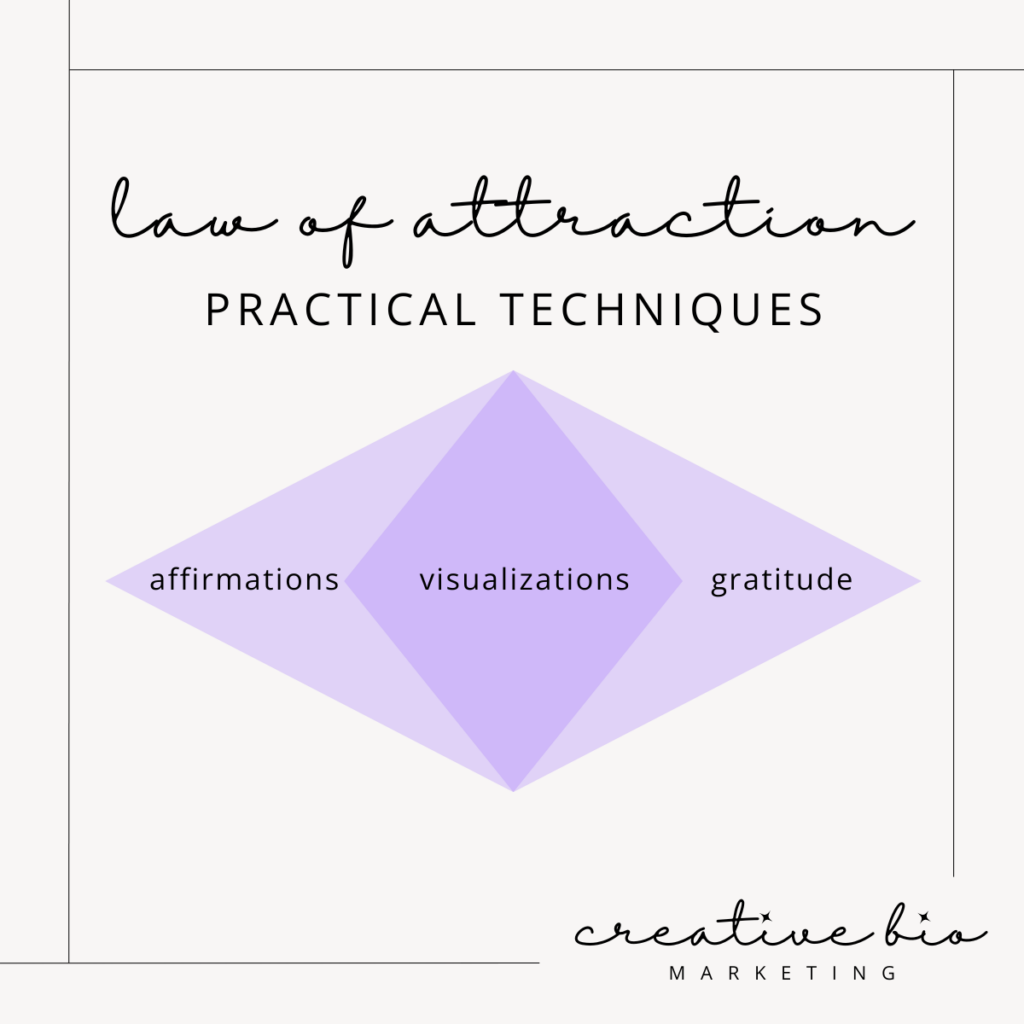
The Secret” by Rhonda Byrne resonates deeply with my experiences, articulating the power of the law of attraction. This universal principle asserts that our thoughts, beliefs, and actions shape our reality. Through practical techniques such as affirmations, visualizations, and gratitude, we can manifest our desires and chart a course toward success.

Law of Attraction Practical Techniques Graphic - Creative Bio

I’m excited to share that embracing these practices has led to the launch of Creative Bio Marketing! It’s been years in the making and a true testament to the power of the law of attraction.

Introducing Creative Bio Marketing

At Creative Bio, we don’t just offer services; we embody a philosophy—an ethos grounded in the transformative potential of aligned action and intention. My approach blends analytical rigor with creative flair, delivering marketing strategies and high-value content that transcend conventional boundaries. Built on a foundation of curiosity, innovation, and a steadfast commitment to excellence, we strive to empower clients to harness the full spectrum of their potential and elevate their brands to new heights.

Cheers to You, the Changemakers

I raise a toast to you — the entrepreneurs, innovators, and dedicated game changers who embody the spirit of possibility and attract the change they wish to see in the world. Together, let us embark on a journey of co-creation and transformation, where every vision finds its manifestation, and every dream becomes a reality.

Cheers to the manifestation of your dreams!

Lorem ipsum dolor sit amet, consectetur adipiscing elit. Maecenas feugiat libero quis lobortis mattis. In eget leo ut libero fermentum dapibus a ut diam. Fusce non neque ornare, pellentesque orci imperdiet, tincidunt elit. In pretium lectus vel augue dignissim, non tincidunt purus pretium. Praesent aliquam eget sem vitae porta. Pellentesque erat massa, pretium a iaculis nec, fringilla sed augue. Praesent aliquet facilisis porta. Sed eu euismod nisi, vel efficitur ex.

Lorem ipsum dolor sit amet, consectetur adipiscing elit. Maecenas feugiat libero quis lobortis mattis. In eget leo ut libero fermentum

Lorem ipsum dolor sit amet, consectetur adipiscing elit. Maecenas feugiat libero quis lobortis mattis. In eget leo ut libero fermentum dapibus a ut diam. Fusce non neque ornare, pellentesque orci imperdiet, tincidunt elit. In pretium lectus vel augue dignissim, non tincidunt purus pretium. Praesent aliquam eget sem vitae porta. Pellentesque erat massa, pretium a iaculis nec, fringilla sed augue. Praesent aliquet facilisis porta. Sed eu euismod nisi, vel efficitur ex.

Lorem ipsum dolor sit amet, consectetur adipiscing elit. Maecenas feugiat libero quis lobortis mattis. In eget leo ut libero fermentum dapibus a ut diam. Fusce non neque ornare, pellentesque orci imperdiet, tincidunt elit. In pretium lectus vel augue dignissim, non tincidunt purus pretium. Praesent aliquam eget sem vitae porta. Pellentesque erat massa, pretium a iaculis nec, fringilla sed augue. Praesent aliquet facilisis porta. Sed eu euismod nisi, vel efficitur ex.

Lorem ipsum dolor sit amet, consectetur adipiscing elit. Maecenas feugiat libero quis lobortis mattis. In eget leo ut libero fermentum

Lorem ipsum dolor sit amet, consectetur adipiscing elit. Maecenas feugiat libero quis lobortis mattis. In eget leo ut libero fermentum dapibus a ut diam. Fusce non neque ornare, pellentesque orci imperdiet, tincidunt elit. In pretium lectus vel augue dignissim, non tincidunt purus pretium. Praesent aliquam eget sem vitae porta. Pellentesque erat massa, pretium a iaculis nec, fringilla sed augue. Praesent aliquet facilisis porta. Sed eu euismod nisi, vel efficitur ex.